
Introduction: India’s Most Spiritual Secret — A Krishna Temple in the Sky
Most people have heard of Kedarnath. Thousands visit Tungnath every season. But very few know about a place so remote, so sacred, and so extraordinarily beautiful that it silences even the most seasoned Himalayan travellers the moment they arrive.
Welcome to Yulla Kanda — home to the world’s highest Krishna temple, nestled beside a glacial lake at 3,895 metres (12,778 feet) above sea level, deep in the Rora Valley of Kinnaur district, Himachal Pradesh.
This is not a mainstream trek. There are no selfie-taking crowds, no overpriced chai stalls every hundred metres, no helicopter queues. What you will find here is something far more valuable — a genuine Himalayan experience that combines raw natural beauty, ancient mythology, deep spiritual meaning, and the rare gift of complete solitude.
The Yulla Kanda Krishna temple trek stands apart from every other high-altitude pilgrimage in Himachal Pradesh for one simple reason: while virtually every other major Himalayan trek in the region leads to a Shiva temple — Shrikhand Mahadev, Manimahesh, Kinner Kailash — this trek leads to Lord Krishna. It is the only major Himalayan pilgrimage in northern India dedicated entirely to the divine cowherd of Vrindavan, reimagined here at an altitude that seems closer to heaven than earth.
Whether you are a devoted Krishna bhakt seeking a once-in-a-lifetime spiritual experience, an adventure trekker hunting for Himachal’s most underrated trail, or a curious traveller drawn to off-the-beaten-path destinations — the Yulla Kanda Krishna temple trek deserves to be on your list. This guide tells you everything you need to know.
What Is the Yulla Kanda Krishna Temple Trek?
The Yulla Kanda trek is a spiritual and adventure trekking route located in the Kinnaur district of Himachal Pradesh, in the region known as the Rora Valley. It leads to a high-altitude glacial lake — called Yulla Kanda — at an elevation of approximately 3,895 metres (12,778 feet).
The word “Kanda” in the local Kinnauri dialect means a high-altitude lake. And standing right at the edge of this sacred lake is the crown jewel of the entire journey — an ancient stone Krishna temple that holds the extraordinary distinction of being the highest Krishna temple in the world.
The total Yulla Kanda Krishna temple trek distance from Yulla Khas Village to the lake and back is approximately 18–24 km round trip (varying slightly depending on route and starting point). The trail is classified as Easy to Moderate in difficulty, making it accessible to reasonably fit first-time Himalayan trekkers, though the final ascent to the lake requires solid effort due to steep gradients and high altitude.
What makes this trek truly special is the convergence of four experiences in a single journey:
- A world-record spiritual monument — the highest Krishna temple on earth
- Ancient Pandava mythology woven into every rock and stream
- The extraordinary landscapes of Kinnaur — pine forests, apple orchards, glacial meadows, and Himalayan peaks
- An authentic cultural immersion into the traditional life of the Kinnauri people
In a world where most popular trekking routes have become overcrowded and over-commercialized, the Krishna temple trek in Himachal still offers something increasingly rare: the real Himalayas.
The Mythology: Why Is There a Krishna Temple in the Himalayas?
To understand the Yulla Kanda temple, you must first understand its legend — and it is a story that weaves together the two greatest epics of Hinduism in one extraordinary place.
According to local belief and oral tradition passed through generations of Kinnauri villages, the sacred lake at Yulla Kanda was created by the Pandavas during their period of exile in the Himalayas. The five Pandava brothers — Yudhishthira, Bhima, Arjuna, Nakula, and Sahadeva — are said to have meditated in this high-altitude valley, seeking peace and divine guidance during the most turbulent period of their lives.
After creating the lake through their spiritual powers, the temple to Lord Krishna was constructed here — a tribute to their beloved friend, guide, and charioteer, whose wisdom in the Bhagavad Gita had sustained them through the horrors of the Kurukshetra war. This makes Yulla Kanda one of the very few places in India where Krishna and the Pandavas are venerated together in a Himalayan setting, far from the plains of Mathura, Vrindavan, or Dwarka.
The Janmashtami festival at Yulla Kanda traces its modern form to King Kehari Singh of the Bushahr estate — the ruling family of the historical Bushahr kingdom — who is credited with instituting the annual celebration of Lord Krishna’s birth anniversary at this sacred site. Even today, the Yulla Kanda temple is considered associated with the Bushahr estate, giving it a unique historical and royal significance alongside its spiritual one.
Another fascinating legend of Yulla Kanda involves a traditional Kinnauri cap (topi). According to local belief, pilgrims who place their woollen Kinnauri topi upside down on the surface of the lake can discover their destiny for the coming year:
- If the cap floats across to the other side without sinking, the person will have a prosperous and blessed year — their wishes will come true.
- If the cap sinks or fails to cross, the coming year may bring challenges and difficulties.
This ritual, performed most widely during the annual Janmashtami celebration, draws hundreds of local pilgrims and devotees who trek up to the lake — some barefoot, in an act of pure devotion — to float their caps and seek the blessing of Lord Krishna.
The World’s Highest Krishna Temple: What Makes It So Special?
When we say “world’s highest Krishna temple”, the claim is as significant as it sounds. Most major Krishna temples — Dwarkadhish in Gujarat, Vrindavan in Uttar Pradesh, the ISKCON temples worldwide — are located in plains or low-altitude cities. The idea of a Krishna temple at nearly 4,000 metres, surrounded by glaciers and Himalayan peaks, represents a profound and unexpected expression of devotion.
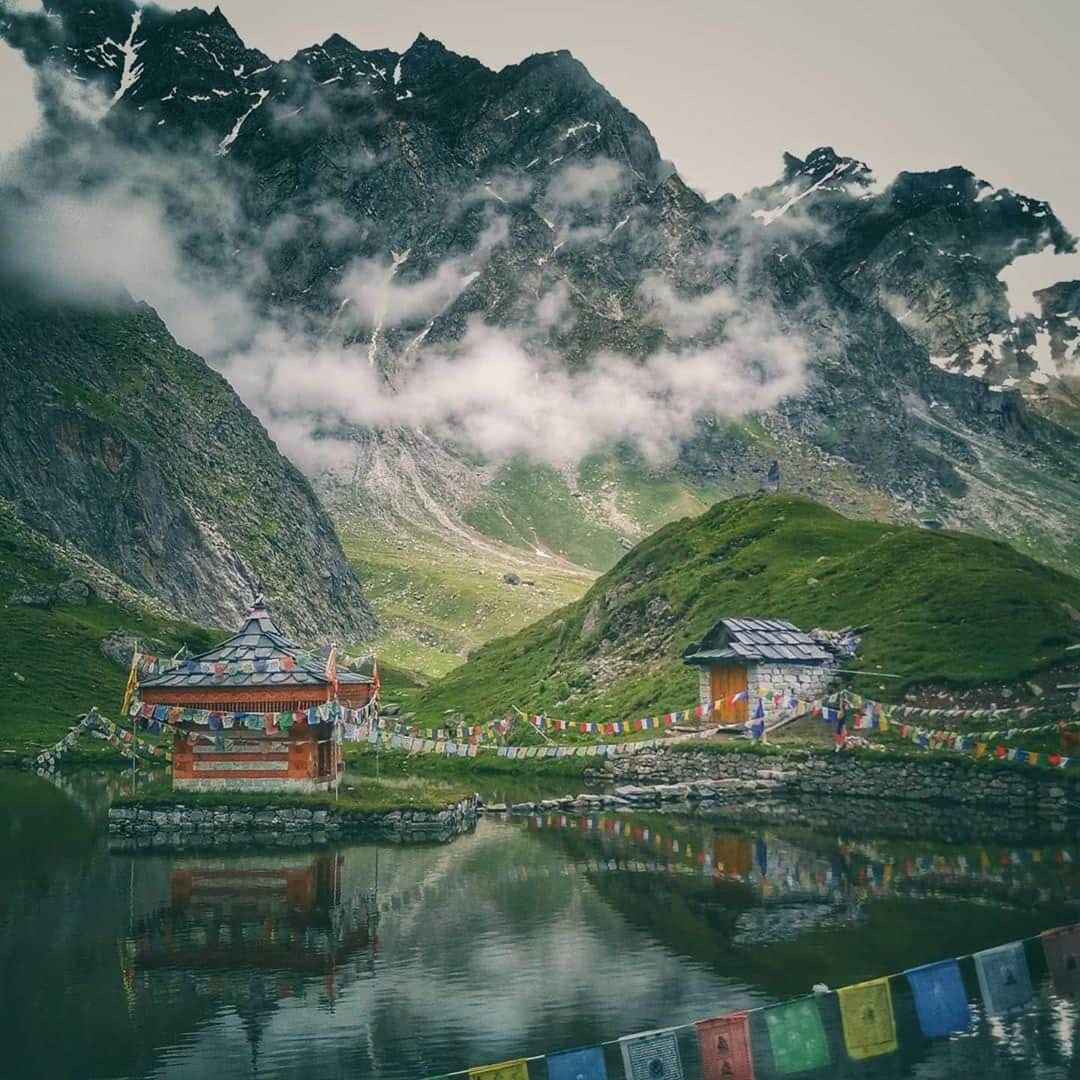
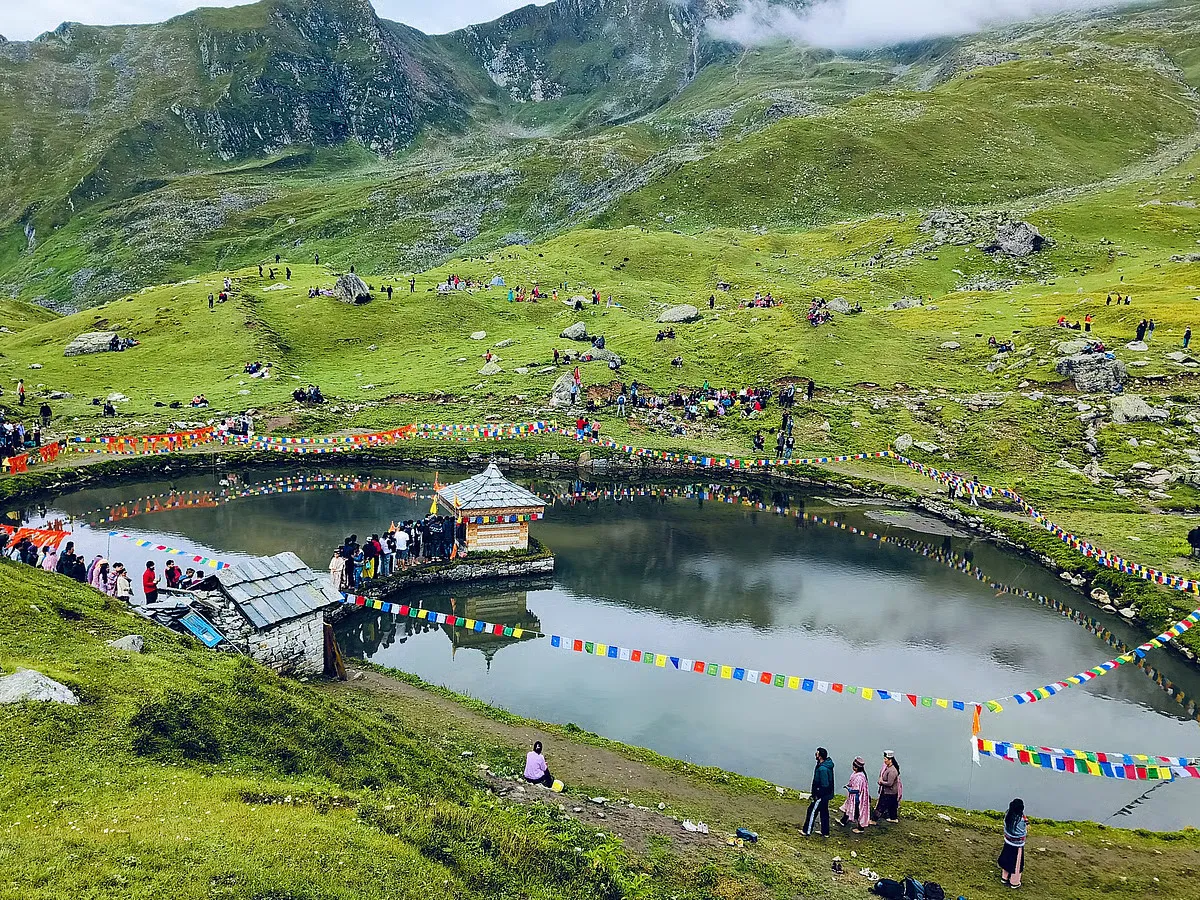
The temple at Yulla Kanda is ancient in construction, built using the traditional stone architecture of the Kinnaur region — the same weathered grey stone used in temples throughout the district. It stands right at the edge of the glacial lake, and on days when the water is calm, the temple’s reflection shimmers in the turquoise surface below — creating an image of such ethereal beauty that many pilgrims describe it as one of the most spiritually moving sights of their lives.
Unlike the elaborate, well-funded shrines of the plains, this highest Krishna temple in the world is deliberately austere. There is no gilded dome, no massive complex of support buildings. Just a small, ancient, stone temple, prayer flags fluttering in the thin mountain air, and the overwhelming silence of the Himalayas.
The lake itself is considered sacred. Local tradition holds that taking a dip in the icy waters of the lake cleanses the soul of all sins and purifies the body of illness. The water, fed by glacial meltwater and Himalayan springs, is crystal clear and bitterly cold even in summer. Hundreds of pilgrims take a ritual dip here during Janmashtami, despite temperatures that would deter most casual swimmers.
People of all religions, castes, and creeds are welcome at the Yulla Kanda temple — a tradition of inclusivity that the local community is deeply proud of. Everyone who arrives, regardless of their faith, is welcomed with warmth and hospitality, reflecting the Kinnauri spirit of open-hearted mountain generosity.
Yulla Kanda Krishna Temple Trek Distance and Route
Starting Point: Yulla Khas Village
The Yulla Kanda trek begins at Yulla Khas Village — a small, traditional Kinnauri hamlet at approximately 2,985 metres (9,793 feet) above sea level. This village, located about 3 km from Urni village and accessible by road from Tapri, is the designated trailhead for the trek.
Yulla Khas is a delightful introduction to Kinnauri life. The village is famous for its Kinnauri apple orchards — the same variety that makes Kinnaur one of India’s finest apple-producing regions — as well as its traditional wooden houses with slate roofs, intricate carved balconies, and warm-hearted residents who have lived alongside these mountains for generations. Staying in Yulla Khas on the eve of your trek allows for valuable acclimatization and a genuinely immersive cultural experience.
Trek Route Overview
Yulla Khas Village → Dense Forest Section → Alpine Meadows (Bugyals) → Base Camp (~3,500 m) → Yulla Kanda Lake and Temple (3,895 m)
Day 1 (Trek Day): Yulla Khas Village to Base Camp
- Distance: ~10–12 km
- Duration: 5–6 hours
- Terrain: The trail begins on stone steps through the village itself and then enters dense forests of pine, oak, and deodar. The path winds alongside gurgling streams, passes through small clearings with mountain views, and gradually ascends into open alpine meadows. The forests of Kinnaur’s lower Rora Valley are among the most beautiful in Himachal — thick, aromatic, and alive with birdsong.
- Camp: Alpine tent campsite in the meadow near the treeline, at approximately 3,500 metres.
The meadow base camp is one of the most peaceful spots on the entire Yulla Kanda Krishna temple trek route. As the sun sets behind the Kinner Kailash range to the north, the peaks turn coral pink and gold. The silence at this altitude is profound — no road noise, no city sounds, nothing but the wind and the distant sound of a stream.
Day 2 (Summit Day): Base Camp to Yulla Kanda Lake and Temple
- Distance: ~2 km (steep)
- Duration: 1.5–2.5 hours (ascent)
- Terrain: The final push to the lake is short but demanding. The trail ascends steeply through a rocky landscape with thinning vegetation. The altitude (nearing 3,900 metres) means the air is noticeably thinner, and most trekkers need to pause and breathe more frequently. But as you crest the final ridge and the lake opens up before you — turquoise water, the ancient stone temple at its edge, snow-capped peaks all around — the effort dissolves completely.
Total Yulla Kanda Krishna temple trek distance (round trip): approximately 18–24 km depending on exact starting point and route variations.

Kinnaur Krishna Temple Trek: Complete Itinerary
4-Day Itinerary from Delhi (Recommended)
Day 1: Delhi → Tapri / Shimla (Overnight Journey) Board an overnight Volvo bus or private vehicle from Delhi to Shimla (~8–9 hours), then continue by road to Tapri in Kinnaur Valley (~7–8 more hours from Shimla). The road follows the Sutlej River and passes through the towns of Rampur Bushahr and Wangtu, with apple orchards, terraced fields, and dramatic canyon landscapes. Arrive at Tapri by evening. Check into a guesthouse, rest, and prepare for the trek.
Tapri is the gateway town for the Yulla Kanda trek in Kinnaur. Stock up on any supplies needed here.
Day 2: Tapri → Yulla Khas Village → Base Camp (Trek Day 1) Rise early and drive from Tapri to Yulla Khas Village (~30 minutes by private taxi — the road is steep and bumpy, requiring a local driver). Arrive at the village, meet your guide, and begin the trek after a briefing session.
Trek through the village’s stone-staired lanes, enter the deodar and oak forest, cross glacial streams, and ascend into the open alpine meadows of Rora Valley. Wildflowers carpet the trail in summer. Arrive at base camp (approx. 3,500 metres) by late afternoon. Set up tents, enjoy hot soup, and spend the evening absorbing the extraordinary mountain silence.
Day 3: Base Camp → Yulla Kanda Lake and Highest Krishna Temple → Descent This is the highlight of the entire Yulla Kanda Krishna temple trek — the day you reach the world’s highest Krishna temple.
Start early (7:00 AM recommended) to make the steep 2 km final ascent to the lake. As you arrive at the Yulla Kanda Lake, take in the view — the ancient stone Krishna temple reflected in the glacial water, the Kinner Kailash range gleaming behind it, and the rare silence of a high Himalayan sacred site that most of the world has never heard of.
Offer your prayers at the highest Krishna temple in the world. Participate in the traditional Kinnauri topi floating ritual if you have a cap. If conditions allow, take a ceremonial dip in the sacred waters. Spend as long here as you need — there is no rush, and this is a place that rewards stillness.
Begin the descent by noon. Trek down through the meadows and forests back to Yulla Khas, then drive back to Tapri. Overnight rest.
Day 4: Tapri → Shimla → Delhi (Return Journey) Begin the return journey to Shimla (~7–8 hours) and connect to Delhi by overnight bus or taxi. Arrive in Delhi the following morning.
How to Reach Yulla Kanda — Kinnaur, Himachal Pradesh
From Delhi
By Bus: Board an overnight Volvo/Tempo Traveller from Delhi’s ISBT Kashmiri Gate to Shimla (~8–9 hours). From Shimla, take a local HRTC bus or shared taxi towards Reckong Peo (district headquarters of Kinnaur). Alight at Tapri — the closest major town to the Yulla Kanda base. Distance from Delhi to Tapri: approximately 550 km.
By Private Vehicle: Drive from Delhi via NH-44 to Chandigarh, then NH-5 (Hindustan-Tibet Road) through Shimla, Rampur Bushahr, and along the Sutlej River to Tapri. The road journey from Shimla to Tapri takes 7–9 hours on winding mountain roads.
By Train + Road: Take a train to Kalka (connected to Delhi via Shatabdi Express), then take the famous Kalka-Shimla Toy Train or a taxi to Shimla. From Shimla, proceed by road to Tapri.
From Shimla
- Distance: ~200 km via NH-5
- Duration: 7–9 hours by road
- Route: Shimla → Rampur Bushahr → Wangtu → Tapri
From Tapri to Yulla Khas Village
- Distance: ~15–20 km
- Duration: ~30–45 minutes by private taxi
- A local driver familiar with the route is essential — the road to Yulla Khas is steep, narrow, and unpaved in sections.
Nearest Airport
Shimla Airport (Jubbarhatti) — approximately 190 km from Tapri. From the airport, hire a taxi directly to Tapri (6–8 hours).
Chandigarh Airport — approximately 320 km from Tapri. More flight options available; connect to Shimla by road or continue directly to Tapri by taxi.
Best Time to Visit Yulla Kanda Krishna Temple Trek
The Yulla Kanda trek is a seasonal route, with the window for safe and comfortable trekking running from mid-May to mid-October. Within this period, different months offer distinct experiences:
May–June: Fresh Season (Recommended)
As the winter snow melts, the trail gradually opens. May and June bring crisp, clear air, excellent mountain visibility, and the fresh greenery of early summer. Wildflowers begin blooming in the meadows. Temperatures during the day are pleasant (10°C–18°C), though nights at base camp drop to near freezing.
This is an ideal window for those who prefer quieter trails and dramatic, snow-flecked scenery around the Yulla Kanda Lake. The highest Krishna temple in the world looks particularly dramatic when surrounded by residual snow.
July–August: Peak Wildflower Season
The monsoon months transform the Rora Valley into a landscape of extraordinary lushness. The meadows burst with wildflowers — rhododendrons, primulas, potentillas, and dozens of other alpine species create a carpet of colour. The forests are emerald green, streams run full, and the mountains wear a deep vibrancy.
Janmashtami falls in July or August (depending on the Hindu lunar calendar), which is when the Yulla Kanda Krishna temple trek reaches its spiritual peak. Hundreds of local pilgrims from Kinnaur and neighbouring districts trek up to the lake to celebrate Lord Krishna’s birthday. The atmosphere is festive, devotional, and deeply moving. If you want to experience the Kinnaur Krishna temple at its most alive, plan your visit around Janmashtami.
Note: Light rain showers are common during monsoon. Trails can be slippery; waterproof gear is essential.
September–October: Golden Season (Also Excellent)
Post-monsoon Kinnaur is stunning. The air is crystalline, the skies are deep blue, visibility is at its best, and the landscape turns golden and amber as autumn arrives. The trails are less crowded, and the high-altitude views from Yulla Kanda are sharper than at any other time of year.
The Kinnauri apple harvest is in full swing in September-October — the orchards of Yulla Khas are laden with ripe, fragrant apples. Visiting during this season means you return from the highest Krishna temple trek with both spiritual elevation and a bag full of the finest apples in India.
November–April: Closed Season
Heavy snowfall closes the trail from November onwards. The lake freezes over, and the route to the temple becomes impassable. Trekking during this period is dangerous and not recommended.
Yulla Kanda Trek Difficulty: What to Expect
The Yulla Kanda Krishna temple trek is graded Easy to Moderate overall — making it one of the more accessible high-altitude treks in Himachal Pradesh.
Why it’s suitable for beginners:
- The trail is well-defined for most of its length
- The gradient is mostly gradual, with forests and meadows providing natural rest opportunities
- The total distance is manageable over 2–3 days without extreme daily mileage
- The trek requires no technical climbing equipment
Why it still demands preparation:
- The final 2 km to Yulla Kanda Lake is steep and physically demanding
- The altitude (3,895 metres at the lake) is significant — altitude sickness is a real risk for those arriving from the plains without acclimatization
- Base altitude in Kinnaur is higher than many other Himachal trekking regions, meaning less time to adapt
- Trail surfaces in the forest section can be wet and slippery during the monsoon
Who should NOT attempt this trek without medical consultation:
- People with heart conditions, blood pressure issues, or respiratory problems
- Those who have never been above 3,000 metres before
- Anyone with a history of altitude sickness
Fitness preparation advice: At least 3–4 weeks before the Yulla Kanda Krishna temple trek, build your cardiovascular fitness through daily brisk walking (5–8 km), stair climbing, and light jogging. The more fit you arrive, the more you will enjoy the experience rather than merely endure it.
Things to Do at Yulla Kanda
Darshan at the Highest Krishna Temple in the World The primary reason most people undertake this Krishna temple trek in Himachal is to offer prayers at the ancient shrine. The experience of standing before a deity of Lord Krishna at nearly 4,000 metres — surrounded by Himalayan peaks, beside a glacial lake — is genuinely unlike any other religious experience in India.
The Sacred Lake Dip Taking a dip in the icy glacial waters of Yulla Kanda Lake is believed to cleanse the soul. Even if you don’t swim, dipping your hands in the water and offering a silent prayer carries deep significance for most visitors.
The Kinnauri Topi Ritual Try the famous destiny-revealing ritual — float your traditional Kinnauri cap upside down on the lake’s surface and observe its fate. It is one of the most unique and culturally specific ritual experiences available anywhere in the Himalayas.
Janmashtami Festival Celebrations If you time your visit around Janmashtami (usually August), you will witness a spectacular mountain festival — traditional music, devotional songs, communal prayers, and the joyful energy of hundreds of pilgrims celebrating Krishna’s birthday at 3,895 metres. It is a sight few outsiders ever witness.
Wildlife and Bird Watching The forests of Rora Valley are rich in Himalayan biodiversity. Keep your eyes open for Himalayan Monal (the state bird of Himachal Pradesh), various species of woodpeckers, eagles, and if you are very fortunate, glimpses of musk deer or Himalayan black bear in the deeper forest sections.
Photography The Yulla Kanda lake and temple provide extraordinary photographic opportunities — the temple’s reflection in the lake, prayer flags against snow-capped peaks, wide meadow shots with the Kinner Kailash range behind them. Golden hour at the base camp meadow is particularly magical.
Kinnauri Village Life Spending time in Yulla Khas Village itself is a cultural experience worth savouring. The traditional wooden architecture, the smell of baking bread and butter tea from homestay kitchens, the sight of village women working in apple orchards — this is Himachal Pradesh at its most authentic.
Flora, Fauna and Landscapes Along the Trail
The Yulla Kanda Krishna temple trek distance of 18–24 km round trip takes you through three distinct ecological zones, each with its own character.
Lower Zone (2,985 m – 3,200 m): Village and Forest Apple orchards, apricot trees, and walnut groves surround Yulla Khas. Above the village, the trail enters a forest of deodar cedar (the sacred tree of the Himalayas), blue pine, silver oak, and horse chestnut. The forest floor is carpeted with ferns and mosses. Streams run clear and cold through this section, and the sound of flowing water accompanies you for much of the early part of the trek.
Middle Zone (3,200 m – 3,600 m): Transition to Meadows As the treeline thins, the landscape opens into rolling alpine meadows known locally as bugyals. During June–August, these meadows are carpeted with wildflowers — blue Himalayan poppies, yellow potentilla, white anemone, pink primula, and the magnificent brahmakamal (a sacred lotus-like flower found only above 3,500 metres in the Himalayas). The views of the surrounding Kinnaur ranges become increasingly dramatic in this zone.
Upper Zone (3,600 m – 3,895 m): Alpine and Glacial Above the meadows, the landscape turns rocky and austere. Snow lingers here even in summer along the edges of the trail. The vegetation is sparse — low cushion plants, alpine grasses, and lichens clinging to exposed boulders. The air is thin and sharp, the sky a deeper blue than any you have seen at lower altitudes, and the silence is absolute. And then — the lake.
Where to Stay During the Yulla Kanda Krishna Temple Trek
In Yulla Khas Village: The village offers homestays with local Kinnauri families — simple, warm, and genuinely hospitable. Staying in a homestay allows you to experience traditional Kinnauri life, sleep under hand-stitched quilts, and wake up to home-cooked meals of buckwheat rotis, local lentils, and fresh apples. This is strongly recommended for the cultural experience alone.
On the Trail (Base Camp): Tent camping in the alpine meadow at approximately 3,500 metres is the standard arrangement for the Yulla Kanda trek. If trekking with an organized company, they will carry and set up tents, provide sleeping bags, and arrange meals at the campsite. Independent trekkers must carry their own camping equipment.
In Tapri: Tapri has several small guesthouses and hotels suitable for the night before or after the trek. Facilities are basic but clean. This is your last point of comfortable rest and hot water before heading into the mountains.
In Rampur Bushahr: A larger town further back on the route with better hotel options, useful for a longer acclimatization day before the trek.
What to Pack for the Yulla Kanda Krishna Temple Trek
Clothing:
- Thermal base layers (top and bottom)
- Fleece jacket or mid-layer insulation
- Waterproof rain jacket (essential in July–August)
- Full-length trekking trousers
- Moisture-wicking t-shirts (3 pairs)
- Warm wool socks (3–4 pairs)
- Waterproof trekking boots with ankle support
- Warm cap, gloves, and neck gaiter
- Sunglasses (UV protection mandatory at high altitude)
- Sun cap for daytime protection
Gear:
- Comfortable 35–45 litre trekking backpack
- Trekking poles (highly useful on steep sections)
- Headlamp with spare batteries
- Sleeping bag (rated to -5°C minimum for base camp nights)
- Reusable water bottle (minimum 2 litres)
- Water purification tablets
- Sunscreen SPF 50+ and lip balm
Health and Safety:
- Basic first aid kit
- Diamox (altitude sickness medication — consult a doctor before use)
- ORS sachets for rehydration
- Pain relief tablets
- Personal prescription medicines
- Hand sanitizer and wet wipes
Essentials:
- Original ID proof (Aadhaar / Passport)
- Sufficient cash (no ATMs near the trailhead)
- Offline maps downloaded (Maps.me or Google Maps offline)
- Portable power bank
- Energy snacks — dry fruits, energy bars, trail mix, chocolate
Travel Tips for the Yulla Kanda Krishna Temple Trek in Himachal Pradesh
1. Acclimatize before trekking. Arrive in Tapri or Yulla Khas a day early and rest. Kinnaur’s baseline altitude is higher than much of Himachal — your body needs time to adjust before you push to 3,895 metres.
2. Start your summit day very early. Begin the final push to the lake by 7:00 AM at the latest. Himalayan weather can deteriorate rapidly by afternoon, and descending in bad conditions is dangerous.
3. Hire a local guide. A knowledgeable local guide not only ensures you don’t lose the trail in the forest sections but also enriches the entire experience with cultural context, local stories, and knowledge of the landscape. Their income directly supports the Kinnauri community.
4. Carry sufficient cash. There are no ATMs at Yulla Khas or anywhere near the trailhead. Stock up on cash in Rampur Bushahr or Tapri before proceeding.
5. Download offline maps. Mobile data signals are weak to nonexistent throughout most of the Yulla Kanda Krishna temple trek route. Download offline maps before leaving cellular coverage.
6. Respect the sacred site. This is an active religious site with deep significance for local communities. Remove your footwear before entering the temple. Keep noise levels respectful. Do not litter — carry all waste out with you.
7. Book accommodation in advance for Janmashtami period. If visiting around the festival, book your homestay and transport weeks in advance. The area gets significantly busier during this period than at any other time of year.
8. Check road conditions before travel. Roads in Kinnaur, particularly between Tapri and Yulla Khas, can be affected by landslides during the monsoon. Always verify current road conditions before setting out.
9. Carry layered clothing even in summer. Temperatures at base camp and the lake can drop below freezing at night even in August. Always be prepared for cold.
10. Leave only footprints. The Rora Valley is a pristine Himalayan environment. The entire ecology of this region is interconnected with the local culture, traditions, and livelihoods. Carry reusable bottles, avoid single-use plastic, and take your waste back with you.

Nearby Attractions: Extending Your Kinnaur Trip
The Kinnaur Krishna temple trek is an ideal centrepiece for a longer exploration of one of Himachal Pradesh’s most magnificent and underexplored districts.
Sarahan and Bhimakali Temple — Located near the Yulla Kanda region, the village of Sarahan is home to the stunning Bhimakali Temple, one of Himachal’s finest examples of traditional Kath-Kuni wooden temple architecture. The surrounding views of the Shrikhand Mahadev range are spectacular.
Rampur Bushahr — The historic capital of the Bushahr kingdom, situated along the Sutlej River. The Padam Palace and traditional bazaar offer a glimpse into Kinnaur’s royal and commercial history.
Kinner Kailash Parikrama — A challenging high-altitude circumambulation route around the sacred Kinner Kailash range, one of the most demanding and spiritually significant treks in Himachal Pradesh.
Chitkul Village — India’s last inhabited village before the Indo-Tibetan border, Chitkul is one of the most beautiful and remote villages in the country — worth the journey for its traditional culture and dramatic mountain setting.
Kalpa Village — A stunning village above Reckong Peo with extraordinary close-up views of the Kinner Kailash peak. Famous for apple orchards and the ancient Hu-Bu-Lan-Kar gompa.
Rupin Pass Trek — For more experienced trekkers, the challenging Rupin Pass trek (connecting Uttarakhand and Himachal) begins in the same Kinnaur region and offers one of the most dramatic high-altitude crossing experiences in the western Himalayas.
Why the Yulla Kanda Trek Is Unlike Any Other Trek in Himachal Pradesh
In a state famed for trekking — Triund, Hampta Pass, Kheerganga, Pin Parvati, Shrikhand Mahadev — the Yulla Kanda highest Krishna temple trek stands apart for reasons that go beyond scenery or altitude.
It’s the only major Himalayan Krishna pilgrimage. While the Himalayas are dominated by Shiva-centric sacred sites, Yulla Kanda represents a completely different spiritual tradition. Coming here feels like discovering a secret that the mountains have kept for centuries.
It remains genuinely uncrowded. Unlike Kedarnath or Triund, where crowds and commercialization have diluted the experience, the Kinnaur Krishna temple trek still delivers the raw, unfiltered Himalayan experience. On most days outside of Janmashtami, you may find yourself with only the mountains for company.
The cultural immersion is unmatched. The Kinnauri people — with their unique blend of Hinduism and Buddhism, their distinctive traditional dress, their warm hospitality, and their ancient relationship with the mountains — are one of the most fascinating communities in India. The Yulla Kanda trek in Himachal Pradesh takes you deep into their world.
The record makes it unforgettable. There is something deeply human about the idea of standing at the world’s highest Krishna temple — knowing that of all the Krishna devotees in the world, very few have been where you are standing. That altitude record is not just a geographic footnote. It is a statement about the infinite reach of devotion.

Frequently Asked Questions (FAQs)
Q: What is the Yulla Kanda Krishna temple trek distance? A: The total round trip distance is approximately 18–24 km from Yulla Khas Village to the lake and back. The one-way distance to the lake is 12–14 km, with the final 2 km being a steep ascent to the lake at 3,895 metres.
Q: Is the Yulla Kanda trek suitable for beginners? A: Yes. The trek is rated Easy to Moderate and is suitable for fit first-time Himalayan trekkers. Basic preparation through regular walking and cardio exercise for 3–4 weeks beforehand is recommended.
Q: What is the best time to visit the highest Krishna temple in Kinnaur? A: May–June (fresh season with snow-flecked scenery), July–August (wildflowers and Janmashtami festival), and September–October (clear skies, golden light, and apple harvest season) are all excellent. The trek closes from November to mid-May due to snowfall.
Q: How do I reach Yulla Khas Village from Delhi? A: Take an overnight bus or drive from Delhi to Shimla (~8–9 hours), then continue by bus or taxi to Tapri in Kinnaur (~7–8 hours from Shimla). From Tapri, a private taxi takes you to Yulla Khas in ~30–45 minutes.
Q: Is the Yulla Kanda temple open year-round? A: No. The temple is primarily accessible during the trekking season (May to October). The route is closed during winter due to snowfall.
Q: Is a guide mandatory for the Yulla Kanda Krishna temple trek? A: Not mandatory, but strongly recommended — especially for first-time visitors and those unfamiliar with the trail. A local guide enhances the experience significantly and supports the local community.
Q: What is the approximate cost of the Yulla Kanda trek? A: A self-organized trek costs approximately ₹5,000–₹10,000 per person (excluding Delhi–Tapri transport), covering basic accommodation, food, and local transport. Organized trekking packages start from around ₹8,000–₹15,000 per person from Shimla, depending on duration and inclusions.
Q: Can I do the Yulla Kanda trek during Janmashtami? A: Absolutely — and it is highly recommended for a deeply spiritual and festive experience. Book accommodation and transport well in advance as this is the busiest period of the year at Yulla Kanda.
Conclusion: Answer the Call of Lord Krishna’s Mountain Abode
There are places on this earth that seem designed to remind you that you are something more than the sum of your daily worries. Places where the landscape is so grand, so old, and so indifferent to human concern that your mind simply quietens — not by effort, but by overwhelm.
The Yulla Kanda Krishna temple trek is one of those places.
Standing beside the world’s highest Krishna temple at 3,895 metres, with a glacial lake at your feet and the Kinner Kailash range gleaming in the distance, you understand something about devotion that no temple in the plains can quite teach you. The people who built this temple here — who climbed through forest and meadow and thin mountain air to establish a shrine to their beloved deity — were telling the world something simple: that the sacred has no altitude limit.
The highest Krishna temple in Kinnaur is not just a geographic record. It is a declaration of love, 1,200 years and 12,000 feet in the making.
Plan your journey. Train your body. Pack your bag. And go find it.
Have you done the Yulla Kanda Krishna temple trek? We’d love to hear your experience — share it in the comments below! And if you found this guide helpful, share it with a fellow traveller who deserves to know about this extraordinary place.